Back boiler removal is a job a great many Rotherham homes still have ahead of them. The back boiler was fitted in enormous numbers across South Yorkshire’s terraced and semi detached housing from the sixties onwards, tucked out of sight behind the gas fire in the living room, and plenty are still running today. If you have one, replacing it is a bigger and more involved job than a straightforward boiler swap, and it helps to understand why before you gather quotes.
What a Back Boiler Actually Is
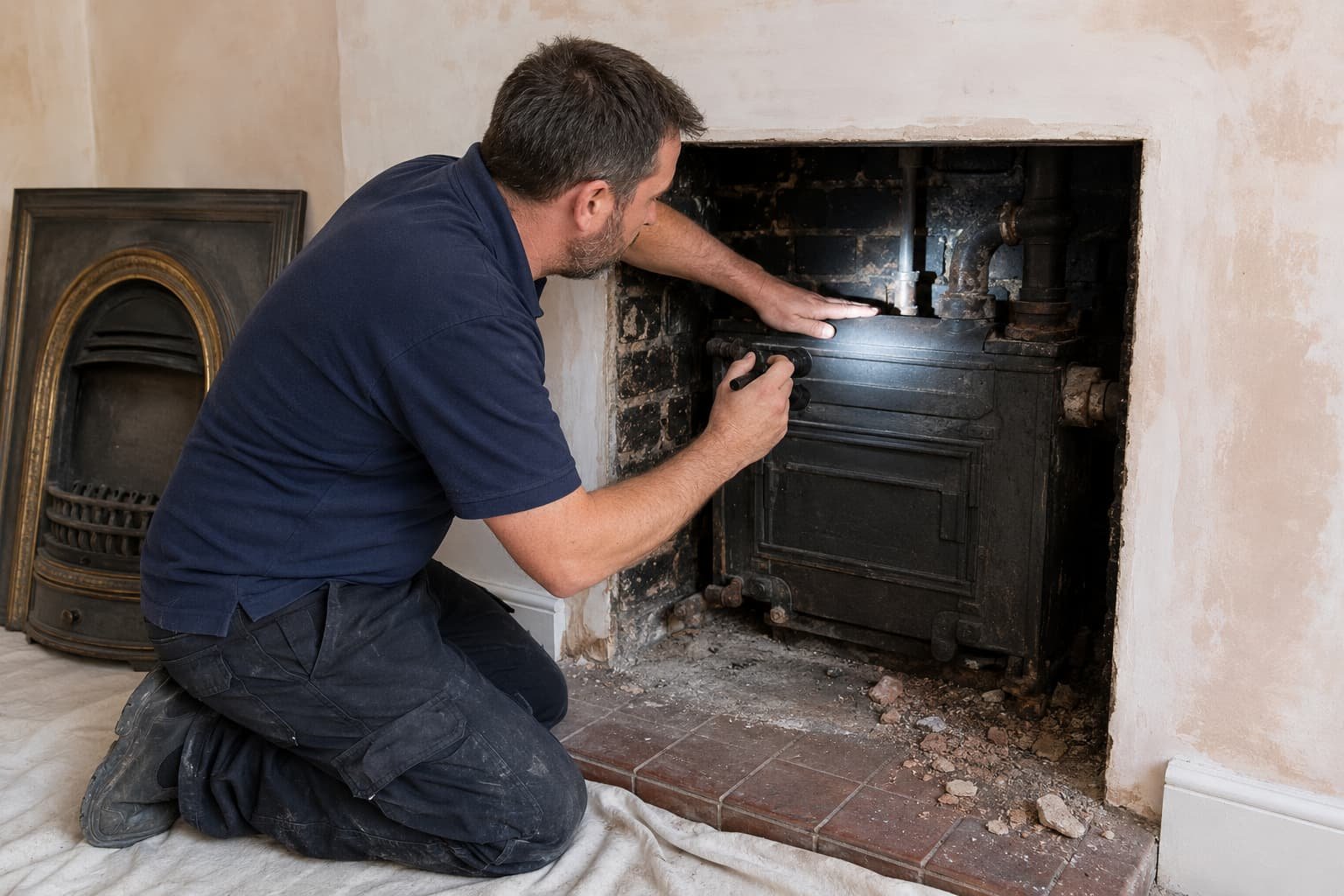
A back boiler is a heat exchanger mounted in the chimney breast recess directly behind a gas fire. The fire in the room and the boiler behind it share the same flue up the chimney. It heats water for the radiators and usually a hot water cylinder in the airing cupboard, while the visible fire warms the room. For decades it was a tidy solution: no boiler taking up kitchen space, and a real fire effect in the living room.
The catch is efficiency. A back boiler is a non condensing appliance by design, and even a well maintained one wastes a substantial share of the gas it burns compared with a modern condensing boiler. As parts grow scarce and running costs climb, the case for replacing one has become straightforward.
Why So Many Remain in Rotherham
The borough’s housing is exactly the stock back boilers were fitted into. Miles of coalfield terraces and interwar and post war semis across the Don and Rother valleys, Herringthorpe, Rawmarsh, Maltby and the pit villages, most built or extended in the decades when the back boiler was the standard specification. Many of those houses have changed hands once or twice with the back boiler still quietly working, because while it works there is no urgent reason to disturb it.
The reason it eventually has to go is usually one of three: it finally fails and parts are no longer available, the running cost becomes impossible to ignore, or a house sale and survey flags it. At that point the removal is not optional, and it is worth knowing what the job involves.
What the Removal Involves
This is a two day job on most houses, and the boiler itself is only part of it. The work runs roughly as follows.
- The gas fire front is removed and the gas supply to it capped off safely.
- The cast iron back boiler unit is disconnected and broken out of the chimney breast recess, which is heavy, awkward work in a confined space.
- The chimney is dealt with. Depending on what remains in use it is either swept and lined, or sealed and ventilated correctly, because an open flue left behind a sealed up recess causes damp and condensation problems.
- The old iron pipework is cut back to sound copper, often revealing that the pipe runs need partial replacement.
- The new combi is sited elsewhere, usually the kitchen, with a new flue, new gas run where needed and new condensate drain.
- The chimney breast is made good, ready for you to redecorate, and you have a usable wall and a room back.
What It Costs
In the Rotherham area, back boiler removal with a new combi installation typically runs between £3,300 and £4,800 fitted and commissioned. That is more than a straight combi swap because of the extra labour: the removal itself, the chimney work, the new flue and gas runs, and the making good afterwards.
Where you sit in that range depends on where the new boiler goes, how much pipework has to be renewed, and the state of the chimney. A quote that comes in dramatically below that band is worth questioning, because the parts that get dropped to hit a low number, the chimney work and the making good, are the parts that cause problems later if they are skipped.
What You Gain
Three things, beyond simply a working heating system. A significant cut in gas consumption, because you are replacing a non condensing appliance with a modern condensing one, and on a back boiler that difference is real rather than marginal. The living room space and the chimney breast back, no longer committed to a gas fire and the unit behind it. And the end of the parts problem, since a current combi is fully supported rather than dependent on a shrinking supply of components for an obsolete unit.
The one thing you lose is the visible flame effect of the gas fire, and for some households that matters. A modern flueless or electric fire can restore the effect if you want it, entirely separately from the heating, and that is a decision you can take later rather than at the same time.
How to Tell If You Have a Back Boiler
Not everyone knows they have one, particularly if they bought the house with it already in place. The clearest sign is a gas fire set into the chimney breast in the living room, combined with central heating and hot water that has no visible boiler anywhere obvious, no unit on the kitchen wall, none in the garage or utility. If the only gas appliance you can point to is the living room fire, yet the radiators and taps run hot, the boiler is almost certainly behind that fire. A hot water cylinder in the airing cupboard is another strong indicator, since back boiler systems are stored hot water systems rather than combis. If you are unsure, an engineer can confirm it in minutes.
Safety and the Case for Not Waiting
A maintained back boiler serviced annually is not inherently dangerous, and there is no need to panic if you have one. But an old, unserviced back boiler sharing a flue with an open gas fire is exactly the configuration where combustion problems matter most, because anything that goes wrong with the flue affects an appliance venting into your living room. The warning signs are the same as for any gas appliance: yellow or orange lazy flames rather than crisp blue, black sooty staining, and above all a carbon monoxide alarm sounding. A working CO alarm in the room is essential with any open flued appliance, and if you do not have one, fit one today regardless of whether you are planning to remove the boiler.
None of this is a reason to rush into a poorly planned job. It is a reason to have an ageing back boiler serviced while it remains in use, and to plan its replacement rather than wait for it to fail in the middle of winter.
Planning the Job
Because it is a two day job with disruption in the living room, back boiler removal is far better planned than forced. If yours is still working but you know its days are numbered, booking the work for spring or summer means you choose the timing, compare quotes properly and are not left without heating while a bigger than expected job runs over.
For how the new boiler is specified and installed, see our pages on combi boiler installation and boiler installation. If the back boiler has already failed and you are deciding between repair and replacement, boiler replacement sets out where that line sits, and our guide to new boiler prices covers what the whole job should include. Independent guidance on heating efficiency is published by the Energy Saving Trust.